In most SaaS companies, competitive intelligence belongs to sales. It feeds competitor monitoring, battlecards, pricing comparisons and objection handling. The same data can also shape product decisions.
When prospects keep choosing another platform, or existing customers leave for the same reasons, the pattern may point to unmet needs, missing capabilities or weaknesses in the product experience. Not every competitive loss is a product problem, though. Sometimes the cause is pricing, onboarding, positioning, implementation or how the sale was run.
The hard part is working out which signals reflect real product weaknesses, and confirming them before they reach the roadmap.
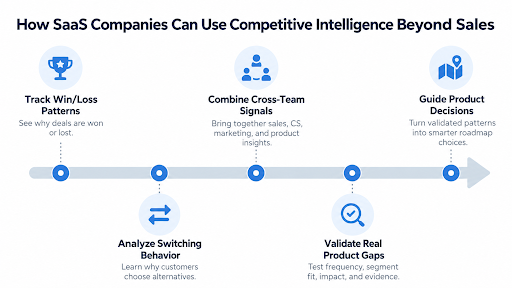
Start With Buyer Decisions, Not Competitor Features
A competitor's new dashboard, AI assistant or integration does not, on its own, create a product need. What matters is buyer behaviour: the capabilities customers actually base their decisions on.
Product teams should look for behavioural patterns. Do prospects stall at the same stage of the buying process? Do customers give the same reason for cancelling?
These patterns answer a more useful question than "What features does the competitor have?" They show what customers need to get done but cannot do well with your product.
Take reporting. If ten lost deals cite a competitor's "better reports", copying that competitor's reporting is not necessarily the answer. Each buyer may have had a different reason for preferring it.
The competitor's feature is only the visible part of the need. Define the job to be done before deciding what to build.
Combine Win/Loss Data With Switching Evidence
Win/loss analysis and churn analysis usually live in separate places. Sales operations reviews lost opportunities, customer success examines churn, marketing tracks competitors, and product teams look at usage and feature requests.
Bringing that information together produces much stronger conclusions. For each competitive win, loss or switch, record:
- the market segment and use case
- whether a competitor was considered or selected
- the main reason for the decision
- the product capabilities mentioned
- the revenue won, lost or at stake
- related requests from current customers
The aim is to find clusters of events rather than react to individual stories.
Say 18 companies report that a product lacks a key CRM integration. At first glance, that looks like a simple feature request.
A closer look might show that 15 of them are enterprise accounts that run core operations through the CRM, and that several chose a competitor specifically because it offered two-way sync. The finding changes from "customers want this integration" to something far more precise: a specific segment, workflow and revenue opportunity.
Customers who have already switched away are a valuable source here. Interviews with them should cover what triggered the search for a replacement, which alternatives they considered, what they chose, and why. For more on reading competitive losses, see what win data actually shows about losing deals to competitors.
Separate Product Gaps From Non-Product Problems
Not every competitive loss is an engineering problem, and this distinction matters more than any other when applying competitive intelligence to product strategy.
A prospect may say a competitor has a "better feature" when the real problem is that the sales team could not show what the product already does. Customers may also switch because implementation took longer than they expected, or because a competitor offered better service.
Competitive feedback needs interpreting before it goes into a plan. A useful set of categories: capability, usability, integrations, performance, reliability, onboarding, pricing and packaging, implementation, positioning, and sales execution.
For example, if customers keep saying a competitor was "simpler to implement", the instinct may be to invest in automating setup. Interviews might instead show that both platforms can do the same things, and the competitor simply provides better templates.
In that case, the better response is a stronger activation process, not new functionality.
Validate the Gap Before Changing the Roadmap
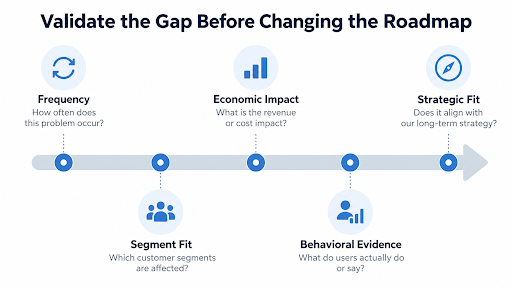
Competitive intelligence should produce hypotheses, not automatic roadmap commitments. Before moving engineering resources, test each gap against five criteria.
Frequency. Does the issue recur across win/loss interviews, churn feedback, support chats, sales notes and customer research?
Segment fit. Does it affect your ideal customer profile, or only customers you are not targeting?
Economic impact. How much potential ARR, retention and expansion revenue is tied to it?
Behavioural evidence. Are people already building workarounds, abandoning workflows, resubmitting requests or using another tool for the job?
Strategic fit. Would solving it strengthen the core product, or pull the product into a different market?
The last question prevents some of the most expensive roadmap mistakes. A lightweight project management tool might lose many enterprise deals for lack of advanced resource planning. Building it could lift enterprise win rates, but it could also bring heavier implementations, longer sales cycles, more support demand and a more complex product for existing users. The gap is real. Filling it may still not make sense.
Real-World Example: Lemon Learning Feeds One Win/Loss Programme Into Sales and Product
Lemon Learning, a European digital adoption platform, set three goals for its win/loss programme: lift sales conversion, sharpen positioning against competitors, and align the product roadmap with what buyers actually wanted. According to a case study by Diffly, the company combined surveys sent to prospects after every opportunity, post-mortems from the sales team, and in-depth interviews on its most important deals.
The measurable gains landed on the sales side. Diffly reports a 20% increase in conversion on deals in direct competition, which it credits to sharper battlecards, and a 15% increase in overall conversion. Lost deals that were re-engaged using loss-reason analysis converted 30% better.
On the product side, Diffly says the interview feedback "informed development priorities" and led to features inspired by prospect and customer needs, though the case study does not say which. That gap is the useful lesson: the sales impact of win/loss research is easy to measure, while the product impact usually goes unrecorded. If you want competitive intelligence to influence the roadmap, log which findings led to which build decisions, so the product impact can be counted as well.
Test Demand Before Making a Major Build
Even with good evidence of a real product gap, development does not have to start with a full build.
Prototypes, beta programmes, limited integrations or a manually delivered version of the feature can all test the hypothesis first.
For example, show a prototype to customers who recently switched to a competitor and ask whether it would have changed their decision. That question tells you far more than asking whether they are interested in the feature.
Usage data from beta users adds another check: whether the feature correlates with activation or retention, and whether target customers actually adopt it. Together, these steps reduce the risk of building functionality that customers mention but never use.
Build a Product Intelligence Loop
Competitive intelligence is most useful when it runs continuously rather than appearing in the occasional presentation.
Sales contributes objections and competitive losses. Customer success adds churn reasons, recurring pain points and the workarounds customers have built. Marketing tracks competitor positioning and shifting market expectations. Product combines all of this with behavioural analytics, interviews, strategic goals and technical constraints.
A regular review of these inputs should produce three outputs:
- new competitive patterns
- hypotheses that need validation
- confirmed gaps that could influence the roadmap
Timing matters too. Switching evidence is most useful while a decision is still open, which is why some teams also track when accounts start competitor trials and time winback outreach around competitor renewals.
From Market Signal to Product Evidence
SaaS companies can collect huge volumes of competitive information, but more information does not automatically produce better products.
Some of the strongest signals come from purchase decisions themselves: what buyers chose, rejected and replaced, and why. Win/loss patterns and switching behaviour are especially valuable because they capture the people regular customer surveys miss: those who decided not to buy, and those who decided not to stay.
Those signals still need validating. A product team has to establish whether a pattern affects the right segment, whether addressing it could bring meaningful revenue, whether real user behaviour reflects it, and whether the solution fits the company's strategy.
Once that process is in place, competitive intelligence stops being material for sales battlecards alone. The goal is not to build what competitors already have, but to understand why customers choose them, find the underlying need, and turn that evidence into better product decisions.
Frequently Asked Questions
How can competitive intelligence be used beyond sales?
Competitive intelligence can inform product decisions as well as sales. Win/loss patterns, switching behaviour and churn reasons show which capabilities buyers base their decisions on. Product teams can use those patterns to find unmet needs, prioritise the roadmap and avoid building features that customers mention but would not actually use.
How do you know if a competitive loss is a product problem?
Classify the loss before acting on it. Many losses that sound like product gaps are really pricing, onboarding, implementation, positioning or sales execution problems. Interview buyers who chose a competitor, ask what triggered their search and why they chose the alternative, and check whether your product could already do what they needed.
What should you check before adding a competitive gap to the roadmap?
Test it against five criteria: frequency across interviews, churn feedback and sales notes; segment fit with your ideal customer profile; economic impact on ARR, retention and expansion; behavioural evidence such as workarounds; and strategic fit with the product's direction. A gap that fails on strategic fit may be real but still not worth filling.
Should you build a feature because a competitor has it?
Not on that basis alone. A competitor's feature shows what one vendor chose to build, not what your buyers need. Define the job the customer is trying to get done, check how often and in which segments the need appears, and test demand with a prototype or beta before committing engineering time.
How do you test demand for a feature before building it?
Use prototypes, beta programmes, limited integrations or a manually delivered version of the feature. Show the prototype to customers who recently switched to a competitor and ask whether it would have changed their decision. Then check beta usage data for adoption by target customers and any link to activation or retention.
Yuliya Melnik is a technical writer at Cleveroad, a software development company. She focuses on turning complex technical topics into clear, practical content that helps readers understand ideas quickly and apply them with confidence.